M(s)
M(s)
 /V:- pd bet metal and sol containing 1 mol/dm3 of aq metal ions at 25°C (298K) & 1 atm (101325Pa) w/ reference to standard hydrogen electrode
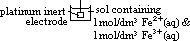
 : pd bet inert Pt electrode & sol w/ 2 aq ions (each of 1 mol/dm3 conc) of same element in diff oxid states at 25°C & 1 atm w/ ref to a standard H electrode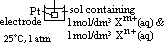
 (reduction) = 0.00V
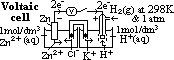 Zn2+(aq) H2(g)cell: measured by voltmetercell = (reduction) + (oxidation)(Zn2+(aq)/Zn(s)) = -ve
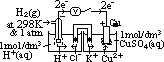
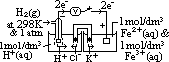 in form: oxidant + n e- reductant => - ) independent of # of moles: reduction (or forms +ve plate) wrt H electrode [-ve : oxidation (or forms -ve plate) wrt H electrode]
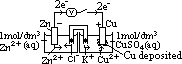 cell = (reduction) + (oxidation)cell: always +vecell = +vecell only tells if reaction possible, kinetics decide rate of reactioncell; large > readily, small > maybe reversible, 0 / -ve > doesn't occur at std conditions (may occur at diff conditions) M(s) (reduction) ∝ conc(reduction) more +ve more +ve (or less -ve) more -ve/ less +ve)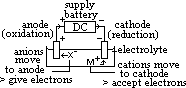
| Voltaic cell | Electrolytic cell |
| chem energy from reaction > elec energy | elec energy used to cause redox reaction |
| reduction at negative cathode | reduction at positive cathode |
| oxidation at positive anode | oxidation at negative anode |
H+(aq) + OH-(aq)] undergo oxid/reduction [OH- higher in series than SO42- > more likely oxidized; H+ lower in series than Na+ > more likely reduced] [vol H2 twice of vol O2]

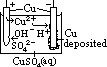
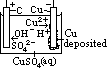
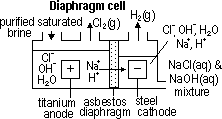 H+(aq) + OH-(aq)